
Illinois advances statewide classroom cellphone restrictions; New York celebrates success from bell-to-bell bans as evidence mounts on screen time harms
States across the political spectrum are limiting phones in class, early results from New York are encouraging, and new research ties screen time to what teens eat.

Illinois lawmakers have approved SB 2427, legislation requiring schools to adopt policies restricting student cellphone use during instructional time, sending the bill to Governor JB Pritzker (D), who is expected to sign it into law. End Chronic Disease was proud to support the effort, which attracted bipartisan backing.
Illinois joins a growing number of states taking action on excessive screen time and student health. Over the past two years, states across the political spectrum, including New York, Oklahoma, Indiana, Kansas, Arkansas, Texas, and Virginia, have enacted or strengthened policies limiting student cellphone use during the school day.
End Chronic Disease has been actively engaged in several of these efforts, supporting legislation and digital wellness initiatives in states including Illinois, Kansas, California, Maryland, Minnesota, and Pennsylvania.
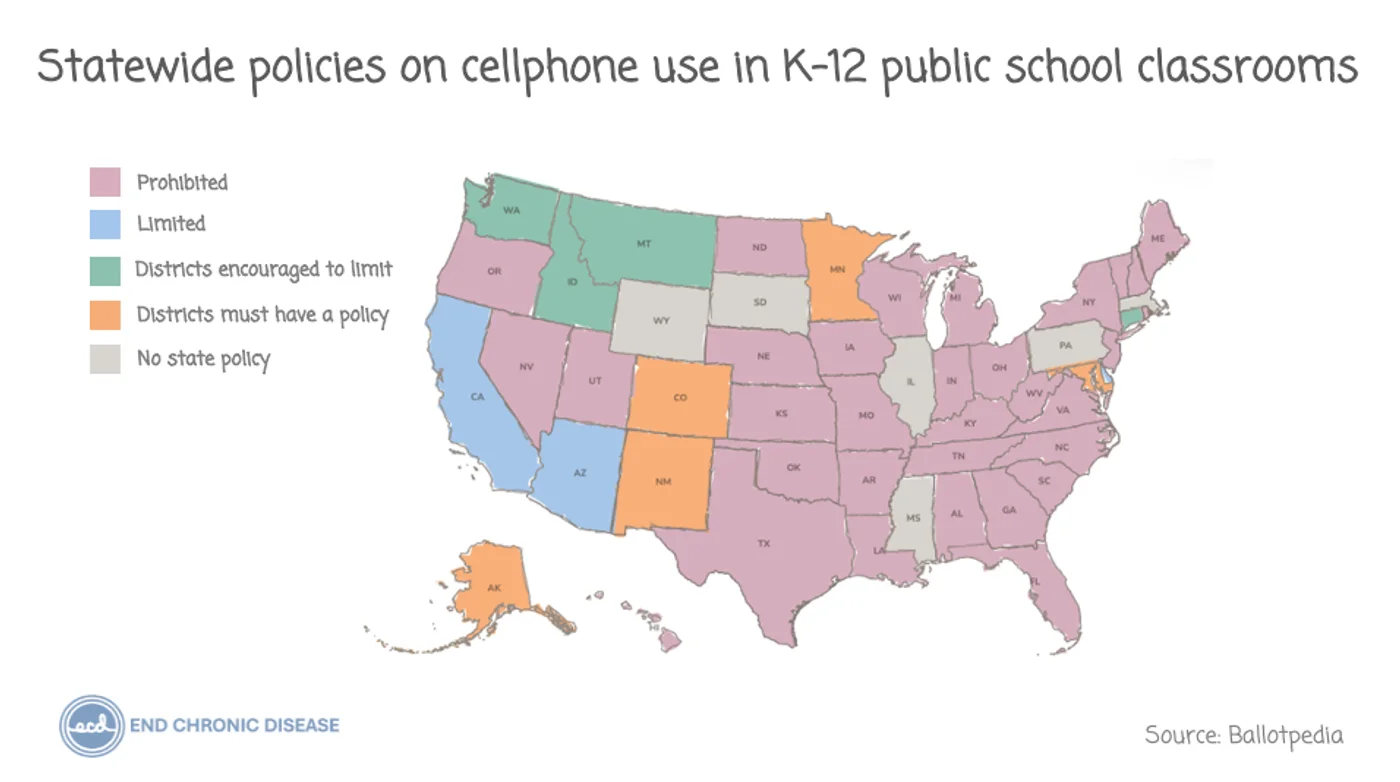
New York, which implemented the nation’s largest statewide “bell-to-bell” cellphone restriction in fall 2025, reported encouraging early results. According to a statewide survey of more than 600 teachers and administrators:
- Roughly 80% reported improvements in student engagement, behavior, and peer interaction;
- Educators noted fewer classroom distractions and stronger social connections among students;
- Some schools reported declines in bullying incidents.
Governor Kathy Hochul highlighted these findings, describing the policy as a success and emphasizing its focus on supporting student well-being.
The momentum behind school cellphone policies comes as concerns about youth screen use continue to grow nationally. In May, the United States Surgeon General’s Office released a public health advisory warning that excessive screen use can contribute to lower-quality sleep, reduced physical activity, weaker in-person relationships, and challenges in academic performance. The advisory highlighted school cellphone restrictions as one strategy that can help create healthier environments for students.
New research published in Pediatric Research adds to those concerns. Researchers analyzing data from more than 6,400 adolescents found that higher screen time use was associated with lower consumption of fruits, vegetables, whole grains, legumes, fiber, and dairy products one year later, while also being linked to higher intake of added sugars and other less healthy dietary patterns. The findings suggest that excessive screen use may influence not only how young people spend their time, but also the everyday behaviors that shape long-term chronic disease risk.
The conversation around technology’s impact is also expanding beyond schools and youth mental health. New research suggests that smartphone adoption may have contributed to broader social changes, including declining birth rates, with researchers pointing to reduced in-person social interaction and changes in relationship formation as potential factors. While the findings remain the subject of ongoing debate, they add to a growing body of research examining how digital technologies may be reshaping social connection and long-term population trends.
Early lessons from states that have already implemented these policies are beginning to emerge. A one-year review of Kentucky’s statewide cellphone restrictions found that schools reporting the strongest improvements in student behavior and classroom focus were generally those with clear, consistent expectations around device use, reinforcing that implementation matters just as much as policy adoption.
End Chronic Disease CEO Kelly McKenna introduced author and social scientist Arthur Brooks at the annual Champions for Youth Summit in Reston, Virginia. Both spoke about the importance of presence, human connection, and finding meaning in everyday life, values increasingly at the center of the conversation around youth technology use. Additionally, McKenna joined KTLA in Los Angeles and later WUSA9 in Washington, D.C., to discuss the growing national conversation around excessive screen use among children. She shared practical steps families can take to promote healthier technology habits.

Follow our work on screen use on the News page, or sign up for our newsletter for the next update.
This update first appeared in the End Chronic Disease newsletter on July 2, 2026. Screen time and diet study: Pediatric Research, 2026. Smartphones and birth rates: NBER Working Paper 35310.