End Chronic Disease continues to elevate recess as a public health priority
Only 10 states require a minimum amount of daily recess for elementary students. New pediatric guidance says it should be protected and never withheld. Here is where the conversation stands.

It’s a little-known fact that’s not getting talked about enough: despite overwhelming evidence that recess is essential to children’s physical, cognitive, social, emotional, and academic development, many schools continue to treat it as optional. To date, only 10 states mandate a minimum daily amount of recess time for elementary school students.
End Chronic Disease is working hard to change the conversation and elevate attention for this serious public-health issue. A recent 2025 study found that while roughly 13 states now require recess in some form, several do not specify a minimum duration, allowing schools to technically comply while offering only minimal recess time.
Luckily, physicians are joining the conversation. For the first time in 13 years, the American Academy of Pediatrics (AAP) issued updated guidance, reaffirming that recess is essential to children’s physical health, academic success, and social-emotional development.
The updated guidance cites growing evidence that children need opportunities to move, play, and recharge throughout the school day. The AAP specifically recommends that recess be protected and never withheld for academic or disciplinary reasons, emphasizing its role in supporting physical activity, stress regulation, learning, and long-term well-being.
The renewed focus on recess comes as lawmakers across the country are increasingly examining physical activity through a public health lens. Over the past year, End Chronic Disease has worked hard to raise the discourse on this issue. We have also worked with policymakers across the political spectrum to advance recess and school fitness legislation, helping elevate the conversation around physical activity as a preventive health strategy. We’ve published op-eds in publications like the New York Post and City & State New York. Kelly McKenna also discussed the issue with Rod Arquette and Greg Hughes on KNRS.
As momentum continues to build, End Chronic Disease has also helped bring the issue to a broader national audience. Recent coverage includes:
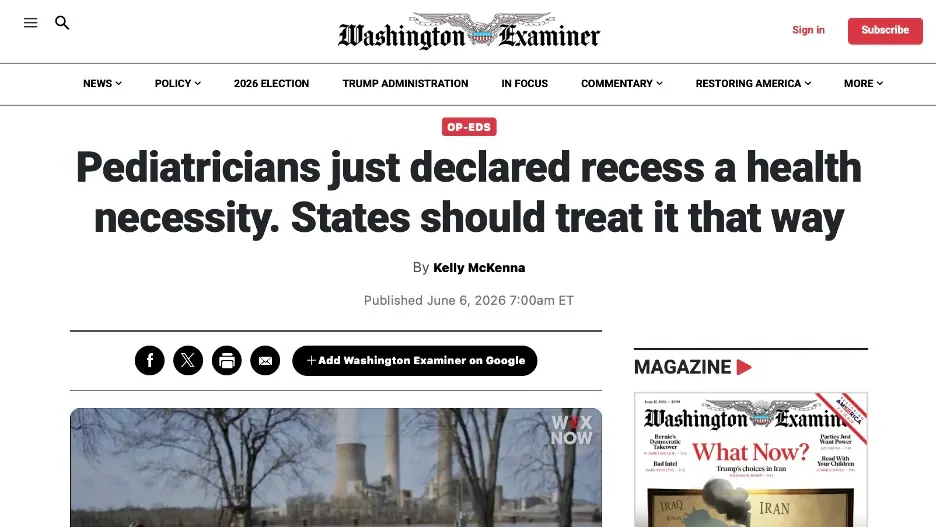
- Kelly McKenna published an op-ed in the Washington Examiner arguing that in light of the AAP guidance, recess should be recognized as an evidence-based public health intervention and protected as part of a broader chronic disease prevention strategy.
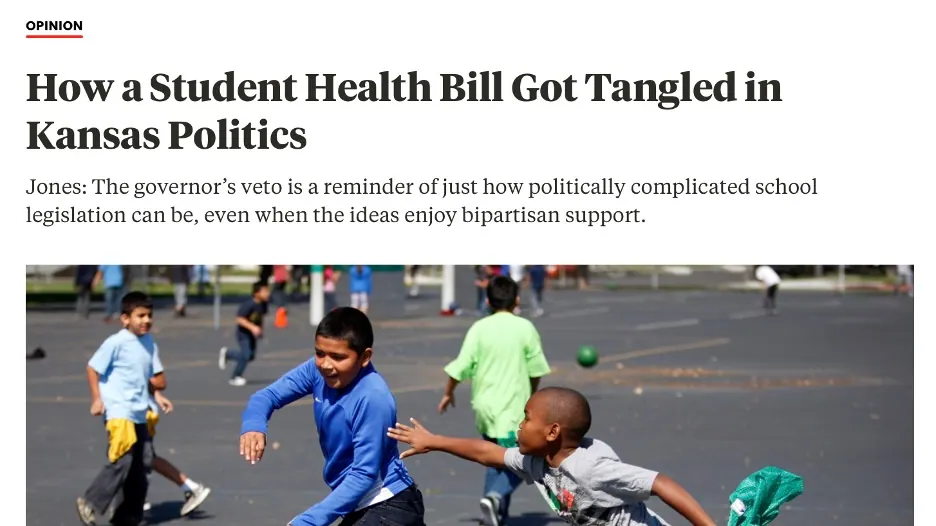
- End Chronic Disease Head of Partnerships Kara Jones published an op-ed in The 74 examining the legislative and political dynamics surrounding recess and school wellness policy in Kansas.
- McKenna’s case for mandatory recess for elementary school students was highlighted in Ballotpedia’s national Hall Pass education newsletter, as part of a featured debate on state recess mandates.
The renewed guidance from the nation’s leading pediatric organization reinforces a message that is increasingly gaining traction among researchers, physicians, educators, and lawmakers alike: protecting time for children to move, play, and be kids is one of the simplest, most effective investments we can make in their health and future well-being.
Follow our recess work on the News page, or sign up for our newsletter for the next update.
This update first appeared in the End Chronic Disease newsletter on July 2, 2026. State recess policy study: International Journal of Behavioral Nutrition and Physical Activity, 2025. AAP policy statement: The Crucial Role of Recess in School Policy, Pediatrics, 2026.