
Why did taxi and ambulance drivers have the lowest share of Alzheimer’s deaths?
A study of nearly 9 million Americans found the lowest proportions of Alzheimer’s deaths in two occupations built on constant navigation. What the research does and does not tell us about spatial reasoning and the brain.

Why did taxi and ambulance drivers have the lowest proportions of deaths attributed to Alzheimer’s disease in a study of nearly 9 million Americans?
A fascinating new piece in The Conversation explores that question, examining a growing body of research into the relationship between spatial navigation and brain health.
One study analyzed nearly 9 million U.S. death certificates and found that, among 443 occupations studied, taxi and ambulance drivers had the lowest adjusted proportions of deaths attributed to Alzheimer’s disease. After accounting for factors including age, sex, race and ethnicity, and education, Alzheimer’s accounted for about 1% of deaths among taxi and ambulance drivers, compared with 1.69% across the study population.
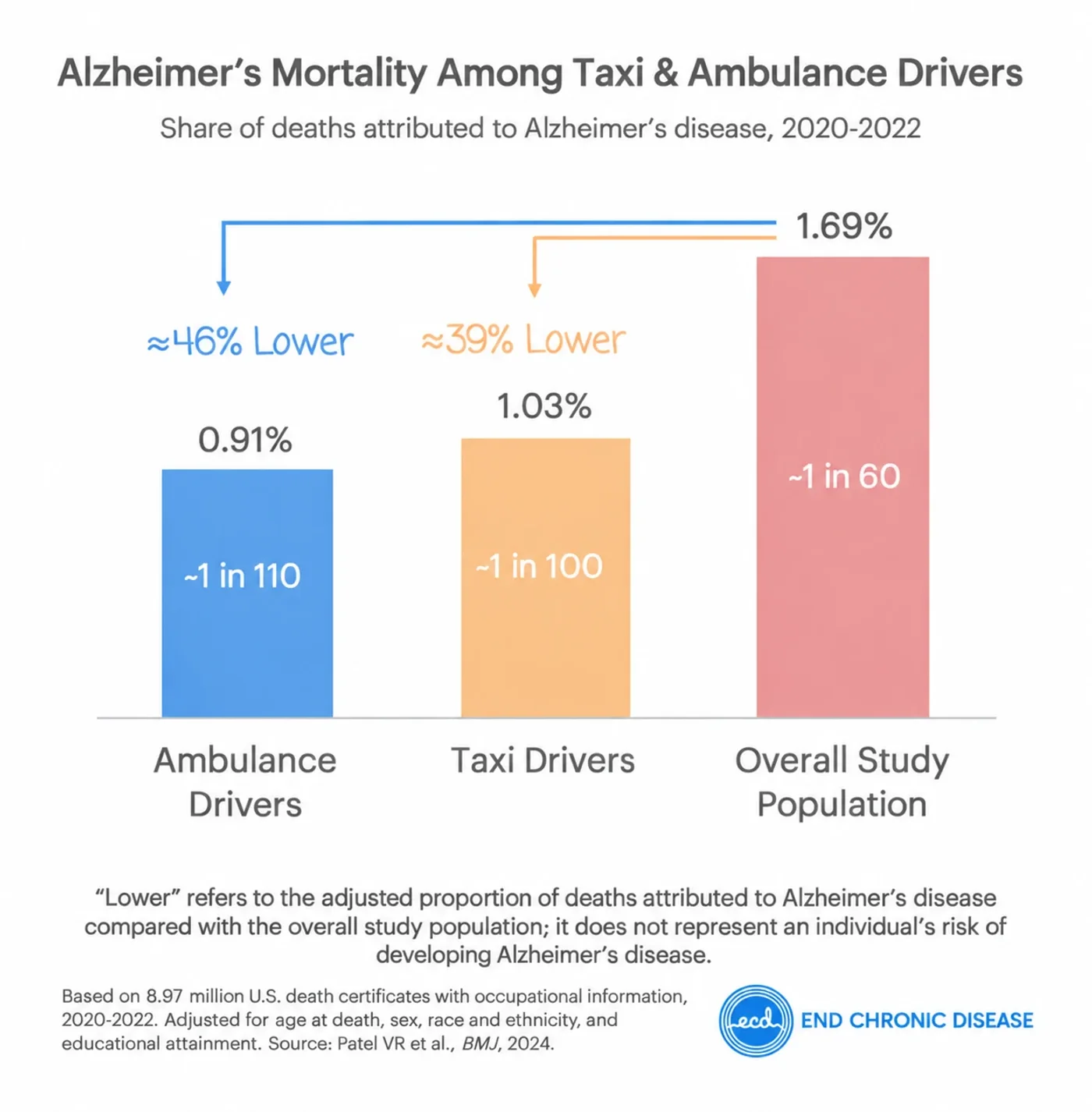
Interestingly, the same pattern did not extend to other professional drivers, such as bus drivers and aircraft pilots. One possible explanation researchers are exploring is the frequent spatial navigation required of taxi and ambulance drivers: locating themselves in space, determining routes, responding to changing conditions, and continually updating a mental map.
Other research adds to the intrigue. A landmark study of London taxi drivers, who traditionally must master an extraordinarily detailed mental map of the city to earn their licenses, found structural differences in the hippocampus, a part of the brain critical to memory and spatial navigation and particularly vulnerable in Alzheimer’s disease. Taxi drivers had greater volume in the posterior hippocampus, while controls had greater volume in an anterior region. The amount of time spent driving a taxi was also associated with these differences.
More recently, a study of 660 older adults found that living in more spatially complex environments was associated with larger volumes in certain brain regions involved in navigation, better spatial performance, and a lower likelihood of an Alzheimer’s or mild cognitive impairment diagnosis.
None of this research establishes that navigating complex routes prevents Alzheimer’s. Other factors, including differences between people who choose and remain in these occupations, could help explain the findings. But together, the studies raise fascinating questions about spatial navigation, the brain’s capacity to adapt to repeated demands, and whether the way we regularly navigate our environments could matter for brain health as we age. They also highlight the important role journalism can play in bringing emerging and unexpected areas of chronic disease research into the public conversation.
Follow our work on neurodegenerative disease on the News page, or sign up for our newsletter for the next one.
Patel VR, et al. Alzheimer’s disease mortality among taxi and ambulance drivers: population based cross sectional study. BMJ, December 2024. doi:10.1136/bmj-2024-082194. Maguire EA, et al. Navigation-related structural change in the hippocampi of taxi drivers. PNAS, 2000. PMC18253. Study of 660 older adults: PMC10883241. Commentary: The Conversation. This spotlight first appeared in the End Chronic Disease newsletter on October 2, 2026.